








A close-knit club of people who breathe Tilburg sociability and have the ambition to always go the extra mile.
Gwen

A close-knit club of people who breathe Tilburg sociability and have the ambition to always go the extra mile.

Local SEO is optimizing your online presence in local search results on Google. The goal: get noticed by potential customers in your immediate area at the time they search for your products or services. By strategically deploying local keywords, an optimized Google Company Profile and local listings, you increase your chances of appearing at the top of the local pack and local organic results. For any business with a physical location or a defined operating area, local SEO is now no longer an extra, but a key ranking factor for growth.
In this article, we’ll take you through everything that makes local SEO in 2026 different than it was just a few years ago. You’ll learn how it works, who it’s interesting for, and what practical tips you can apply today.

Local SEO is a specific form of search engine optimization that focuses on searches with local intent. Think of search terms like “hairdresser Tilburg,” “plumber nearby” or “best pizzeria Eindhoven.” Google recognizes this local search intent and adjusts search results based on the searcher’s location. Local SEO is all about influencing those results in your favor.
Why this has become so important: A sizable portion of all searches have a local component. People search for a nearby business on their phone, compare reviews on Google Maps and often visit the store or website the same day. Statistics from Think with Google show this clearly:
This highlights why it is crucial for local business owners to be highly visible locally. A good local SEO strategy ensures that you are not only found, but chosen at the time when buying intent is highest.
Google uses several criteria to determine which businesses it shows for local searches. The most important are relevance (does your business match the search query), distance (how far are you from the searcher) and prominence (how well known and trustworthy is your business online). The latter factor is determined by your online reputation, the number and quality of reviews, your listings on other websites and your valuable local backlinks.
Unlike regular SEO, your physical location plays a starring role. A webshop without a physical address has a harder time appearing in local search results than a business with an actual location. The way Google presents results also differs: in addition to the regular organic search results, you often see a local pack with three businesses and a map, or results directly in Google Maps.
Local SEO is of interest to any business that depends on customers from a particular area. Whether that is a city, a province or a fifty-kilometer radius. We see roughly four categories where local SEO is an important ranking factor.
Do you have a physical store? Then local SEO is essential to attract foot traffic to your door. Being found locally ensures that people nearby searching for products you sell will find you directly. Say someone searches for “buy coffee machine Tilburg” on a Saturday afternoon. If you are listed in the local pack or at the top, chances are they will walk in your door instead of searching further.
If you run a business with multiple branches, each location must be found well individually. That means own local landing pages for each branch, a Google Company Profile for each location and consistent NAW data everywhere. Someone searching in Den Bosch should find the Bos branch, not the one in Breda. Creating separate, highly optimized local landing pages prevents branches from cannibalizing each other in search results and helps Google match the right location to the right search query.
For service businesses that work in defined regions, such as plumbers, cleaners, roofers or installers, local SEO is often the most important marketing channel. When someone has a leaky faucet and Google asks for help, you want to appear as the first option in local organic results. And because you’re nearby, you can respond faster than a provider from further away. That’s a strong selling point that Google also recognizes and rewards.
If you organize local events, then local SEO helps you be visible in the local community. Whether it’s a music festival, art exhibition, trade show or neighborhood market, optimizing your event for local search increases its reach among people who are actively looking for what’s going on in their area. Combine this with listings in local business directories and calendar sites for best results.
Before we get to the practical tips, it’s good to understand where you want to be visible with your local SEO optimization in the first place. Google shows local results in different ways, and each requires a slightly different approach to attract local traffic to your website at the local level. Local SEO (the English term) and local SEO are used interchangeably and mean the same thing.
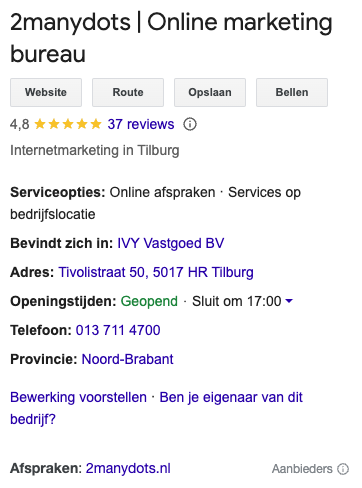
The local pack (or Local 3 Pack) is the small card with three business listings that appears at the top of search results for local searches. This is by far the most valuable local position: it stands out, it shows reviews, opening hours and directions. Those listed here get the vast majority of clicks. Ranking in the local pack is determined almost entirely by your Google Company Profile and not by your website.

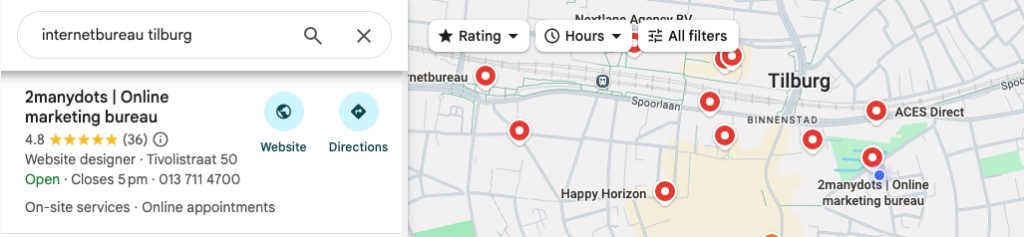
If you click on “more businesses” in the local pack, you will be taken to the Local Finder. Here you’ll see a more comprehensive list of local businesses that match your search. Filters for stars, opening hours and specific products or services help the searcher refine. For your local SEO, this means that even positions outside the top 3 can still drive traffic.
Local searches through Google Maps work similar to Local Finder, but pull results from a larger geographic area. People using Google Maps are often already on the road or planning a specific visit, so buying intent is high. A highly optimized Google Company Profile is the direct basis for your visibility here.
Below or next to the local pack, you see regular organic search results with a local touch. Here, websites rank based on classic SEO factors, but enriched with local signals. This is where local landing pages, local content and your internal link structure make the difference. The beauty: if you rank both here and in the local pack, you take up double the space on page one.
New in 2026, Google is increasingly showing AI Overviews for local searches. These AI summaries draw from multiple sources to provide a direct answer, often including local recommendations. For your local SEO, this means your content must not only be optimized for traditional search results, but also easy for AI to interpret: clear structure, clear answers to questions and well-marked local information via schema markup.
Time for the practical tips. The items below make up a complete local SEO strategy. Pick them up in order, or start with the items where you rank weakest.
Your Google Company Profile (formerly Google My Business) is your digital shop window in Google and on Google Maps. A complete and active profile is by far the biggest lever for local rankings. Fill in EVERYTHING: opening hours, products or services, photos, a good business description with your most important local keywords, and categories that match exactly what you do.
Post regular updates, add fresh photos and respond to every review, including the positive ones. Positive reviews are one of the strongest signals of local authority. Actively ask satisfied customers to leave a review, and make it easy for them with a direct review link.
Specifically for companies with multiple locations: create their own profiles for each location and keep them all up-to-date. This is more work, but essential for local rankings by area.
Do you want to be found on “internet agency Tilburg”? Then that search term should appear in your URL, your meta title, your meta description, your H1 and H2s, and in the page’s body text. But beware of keyword stuffing: write for people, not for search engines. Local keywords should naturally fit into the text.
Good local keyword research is the foundation here. Use tools like the Google Keyword Planner, Semrush or Ahrefs to see what local keywords are being searched for and what the search volumes are. Don’t forget long tail keywords: terms like “affordable plumber Tilburg Reeshof” have less volume, but much higher conversion.
For each operating area or branch, create its own local landing page. Not one general “branches” page with a list, but full-fledged pages with unique content for each location. Describe what you do in that specific area, which neighborhoods or villages you serve, any client cases from that region, and practical information such as parking or public transportation.
The more local relevance and context you add, the more strongly Google associates the page with that location. Avoid duplicate content between location pages: write each page from scratch with the specifics of that location.
NAW stands for name address and phone number (in English: NAP, Name, Address, Phone). These three details should be exactly identical on your website, your Google Company Profile, your social media, local business directories and any other places your business is listed. Consistency in these is essential to your online visibility and helps you be found by local customers. Inconsistencies (a shortened address here, a different phone number there) confuse search engines and undermine your local authority.
At least once a year, walk through all your listings and correct discrepancies. Tools such as Yext or BrightLocal can automate this process if you manage many locations.
Local backlinks are worth their weight in gold for your local findability. When local businesses, newspapers, industry associations or bloggers link to your website, it shows search engines that you are an authority in your region. This is what makes local link building so valuable: quality over quantity, and local relevance over generic domain authority.
Concrete ways to collect local links:
Build these relationships gradually. This is not a sprint but a marathon, and the value accumulates over the years.
Listings in local business directories (citations) help Google confirm the accuracy of your name and address information. Think Phone Book, Detelefoongids, Yelp, industry-specific directories and regional platforms. Make sure you are listed in at least the major general directories, plus the specific directories relevant to your industry.
Quality trumps quantity here. Ten strong, relevant listings with consistent data are more valuable than a hundred random placements on obscure sites.
Structured data (or schema markup) is a way to give search engines additional context about your Web site. For local SEO, the LocalBusiness schema is indispensable. With it, you tell Google explicitly what your business name is, your address, business hours, payment methods, service area and more.
Combine LocalBusiness with the Organization schema for a complete picture, and add Review, Event or Product schemas where relevant. In Rank Math, you can easily set this on a per-page basis via the Schema tab. Well-implemented structured data not only increases your chances of getting rich snippets in search results, but also makes your content more readable for AI search engines and Google Maps.
Reviews are one of the strongest signals for local authority. It’s not just the number that counts, but the freshness (recent reviews are more valuable) and how you handle them. Respond to all reviews, including the negative ones. A professional, solution-oriented response to a critical review shows prospective customers that you are committed.
Actively ask for reviews after a positive customer experience. Make it as easy as possible with a direct link to your review page. Be cautious about incentives: Google prohibits exchanging discounts for reviews and may penalize your profile for doing so.
In addition to your service and product pages, you can increase local visibility with content specifically about your region. Think blog articles about local events, guides to the region, customer case studies from specific areas or news about your participation in local initiatives. This type of content is not directly conversion-oriented, but builds local authority and provides valuable internal links to your most important local landing pages.
An added benefit: this content is often picked up by local media outlets and thus can generate organic backlinks.
Local SEO in 2026 will not be what it was in 2023. AI search engines, AI Overviews and zero-click results are changing how people search locally and how Google presents those results. Three developments to keep an eye on:
A few pitfalls we often encounter in local optimization:
Many local business owners start with the basics themselves: optimize Google Company Profile, make NAW data consistent, collect a few reviews. That’s fine and often gets results quickly. But a complete, structural local SEO strategy takes time, knowledge and consistency. You need to keep up with algorithm updates, monitor your rankings, keep publishing content and build out your local link profile.
At some point, it pays more to bring in a specialist. At 2manydots, we specialize in local SEO optimization and help local businesses structurally improve their local findability. From technical SEO to Google Company Profile management and building valuable local backlinks, we tackle the full picture.
Are you a customer or looking to become a customer of 2manydots? If so, we will take this on completely. Read more about our approach on the Resultsmatter page.

Local SEO is more important than ever in 2026, but also made more complex by AI search results and increasing competition. The basics have remained the same: a strong Google Company Profile, consistent NAW data, local content that matters and a healthy profile of local backlinks. Those who have these fundamentals in place and continue to consistently build on them will win in the long run from local competitors who still think local SEO “can be done in between”.
Want to know where your business stands? Get in touch today!